Monitoring overview
Uptime Monitoring
Know when something goes down.
UptimePilot monitors your critical services and alerts you when they become unavailable, fail checks, or experience problems.
HTTP CHECK TRACE
- ✓DNSResolved18ms
- ✓ConnectionEstablished32ms
- ✓TLS / SSLValid certificate41ms
- ✓HTTP request200 OK146ms
GET /health
Capabilities
Choose the right monitor for each service
Different failures need different checks. UptimePilot keeps each monitoring type in one calm, consistent workflow.
Website Monitoring
Monitor websites and HTTP or HTTPS endpoints.
ExploreAPI Monitoring
Monitor API availability, responses, and performance.
ExploreSSL Monitoring
Track SSL certificate validity and expiration.
ExploreHeartbeat Monitoring
Monitor cron jobs, backups, and scheduled tasks.
ExploreTCP Monitoring
Check whether TCP services are reachable.
Ping Monitoring
Monitor network hosts for availability and latency.
Process
How UptimePilot works
Every monitoring type turns a scheduled check or expected signal into a useful result.
- 1
Choose what you need to monitor.
- 2
UptimePilot runs the scheduled check or waits for the heartbeat.
- 3
The result and timing are recorded.
- 4
Configured failure conditions can create an incident.
- 5
Push and email notifications alert you to the state change.
Use cases
What can you monitor?
Cover user-facing endpoints, network services, certificates, and scheduled work.
Websites
Public pages and HTTP or HTTPS endpoints.
APIs
REST endpoints with custom methods and headers.
Network services
Reachability for TCP services and network hosts.
SSL certificates
Certificate validity and expiration state.
Cron jobs
Recurring jobs that send a heartbeat when complete.
Background workers
Workers expected to report on a schedule.
Scheduled tasks
Scripts, reports, synchronization, and maintenance.
Production infrastructure
The reachable services behind production workflows.
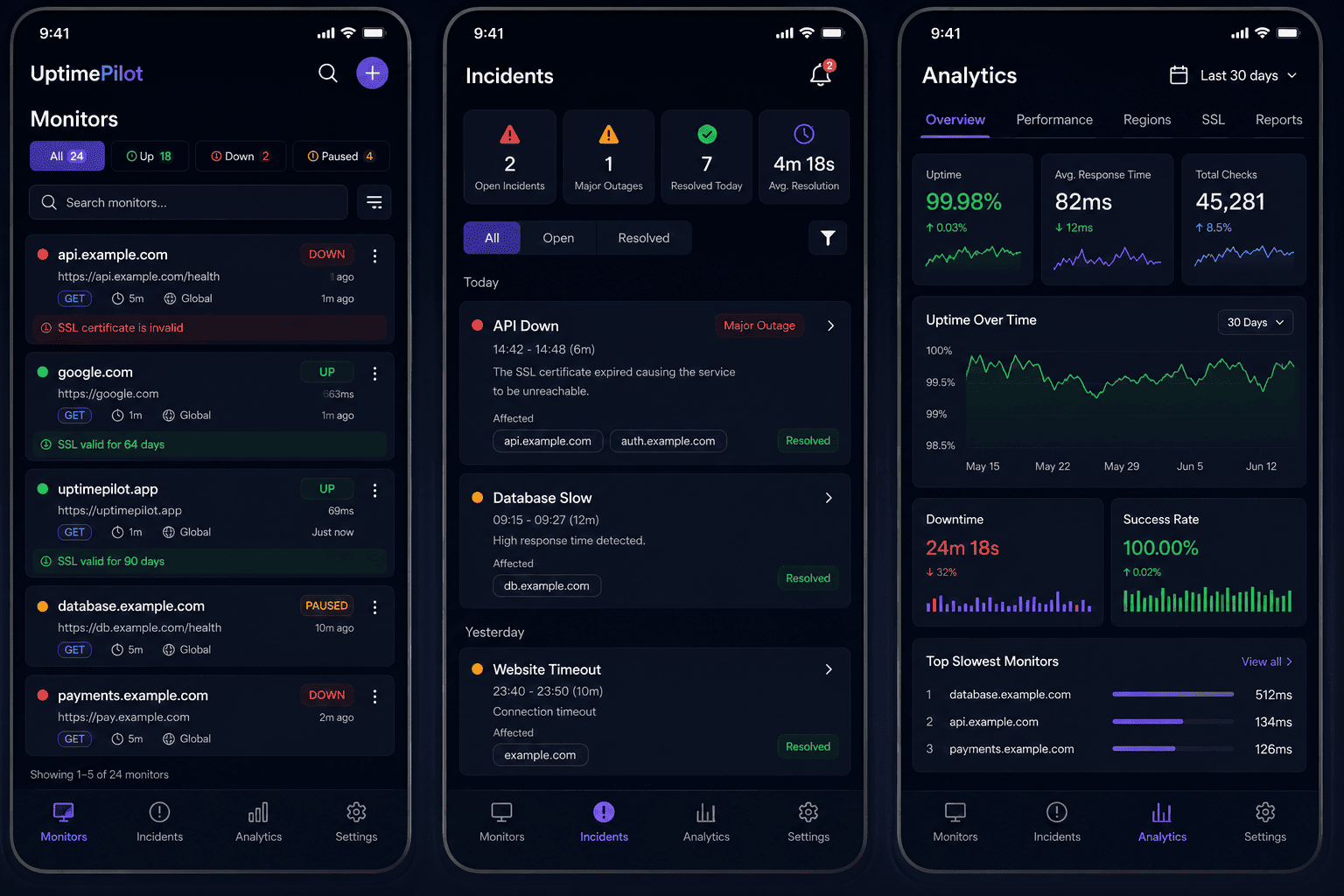
Inside UptimePilot
From downtime detection to incident history
UptimePilot records monitoring results and incidents so you can understand what happened, when it happened, and when the service recovered.
Monitoring history
Review check results and response-time changes over time.
Incident detection
Group failed monitoring states into incidents for investigation.
Clear diagnostics
Inspect the stage, status, or missing signal behind a failure.
FAQ
Questions, answered.
What is uptime monitoring?+
Uptime monitoring checks whether important services are reachable and behaving as expected, then records failures so teams can investigate and respond.
What can UptimePilot monitor?+
UptimePilot supports websites, HTTP and REST APIs, SSL certificates, heartbeat endpoints, TCP services, and network hosts through ping monitoring.
How does UptimePilot detect downtime?+
It evaluates scheduled check results or expected heartbeat signals against each monitor's configured conditions. A failed result can create an incident.
Can I monitor websites and APIs?+
Yes. HTTP and HTTPS monitors support configurable methods, expected status codes, custom headers, intervals, and timeouts.
Can I monitor background jobs?+
Yes. Heartbeat monitoring can watch cron jobs, backups, scheduled scripts, and background workers.
Can I monitor SSL certificates?+
Yes. UptimePilot can track certificate validity and expiration for HTTPS endpoints.
How are monitoring failures handled?+
Failed checks are recorded, can create incidents according to configured rules, and can send push or email notifications through configured channels.
Start monitoring with UptimePilot.
Set up your first monitor and keep its current status, history, incidents, and alerts close at hand.
Start Monitoring