API monitoring
API Monitoring
Know when your API stops working.
Monitor API endpoints continuously and detect downtime, unexpected responses, timeouts, and performance problems before they affect your users.
API CHECK TRACE
- ✓DNSResolved18ms
- ✓ConnectionEstablished32ms
- ✓TLS / SSLValid certificate41ms
- ✓HTTP request200 OK146ms
GET /health
Capabilities
Monitor the API conditions that matter
Go beyond a basic ping by configuring the request and the response your endpoint should return.
Endpoint availability
Check whether an HTTP or HTTPS API endpoint can be reached.
GET, POST, and HEAD
Use the request method appropriate for the endpoint being monitored.
Expected status
Define which HTTP status codes count as healthy.
Response time
Record endpoint latency for each completed check.
Custom headers
Add supported authentication or application headers to requests.
Timeout conditions
Configure how long UptimePilot should wait for a response.
Process
How API monitoring works
A scheduled request turns endpoint behavior into a result you can act on.
- 1
Configure the endpoint, method, headers, and timeout.
- 2
UptimePilot sends the request on the selected interval.
- 3
The response status and timing are recorded.
- 4
The result is evaluated against the expected status codes.
- 5
Failed checks can create incidents and send push or email alerts.
Use cases
API monitoring for real-world systems
Monitor the endpoints that connect your product and keep important workflows moving.
REST APIs
Check public REST endpoints with the method and headers they require.
SaaS backends
Watch the endpoints behind user-facing product flows.
Mobile app APIs
Monitor services your mobile application depends on.
Payment APIs
Check your own payment-related service endpoints for availability.
Authentication endpoints
Detect timeouts and unexpected status codes on auth services.
Internal production APIs
Monitor reachable internal endpoints and production services.
Inside UptimePilot
Request configuration without the noise
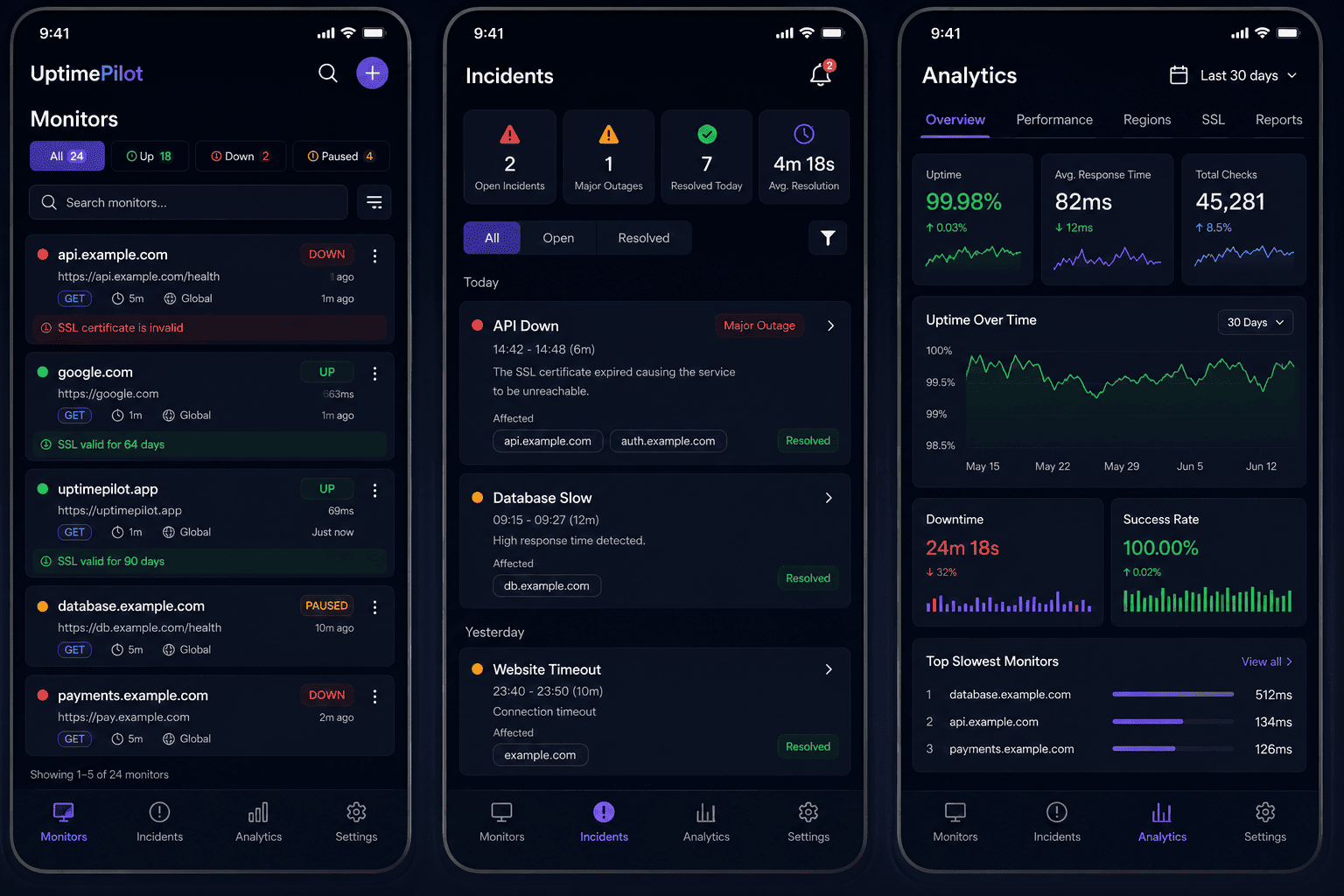
UptimePilot keeps the important request settings and recent results together so developers can see what was checked and why it failed.
Request methods
Configure GET, POST, or HEAD for the endpoint being checked.
Flexible checks
Set monitoring intervals and request timeouts per endpoint.
Response analytics
Review response-time history for monitored APIs.
FAQ
Questions, answered.
What is API monitoring?+
API monitoring sends scheduled requests to an endpoint and records whether it is available, how quickly it responds, and whether the response matches configured conditions.
Can UptimePilot monitor REST APIs?+
Yes. UptimePilot can monitor reachable REST API endpoints over HTTP or HTTPS.
Can I use POST requests?+
Yes. POST is supported, alongside GET and HEAD methods.
Can I configure expected status codes?+
Yes. Each HTTP monitor can define the response status codes that count as successful.
Can I add custom headers?+
Yes. Custom headers can be added for supported authentication and request configuration needs.
Can I monitor API response time?+
Yes. UptimePilot records response time for API checks and makes that history available for review.
Start monitoring your API.
Set up your first monitor and keep its current status, history, incidents, and alerts close at hand.
Start Monitoring